

Quick summary
Rain pushes water toward your foundation. This guide shows how to find the entry point, fix the outside first, and know when a leak needs a professional.
- Difficulty
- Intermediate
- Time
- 2 to 6 hours for the DIY checks and exterior fixes
- Material cost
- $40 to $250 for downspout extensions, sealant and patching materials
- Read time
- 9 min
Rough retail prices for supplies only. Interior drains, sump systems and exterior waterproofing are quoted by a contractor after an inspection and cost far more.
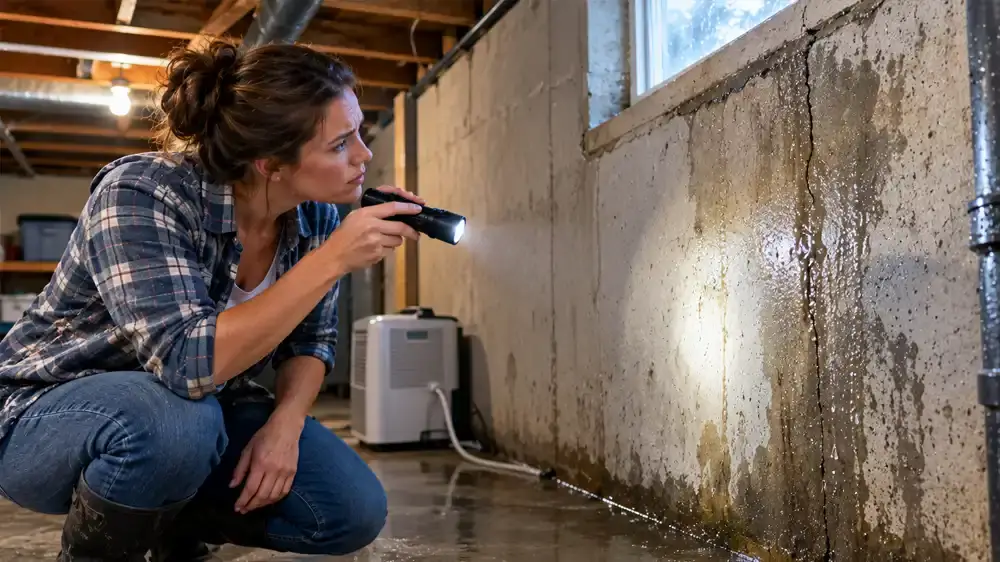
You walk downstairs after a storm and the floor is wet. Maybe it is a damp line along the wall. Maybe it is a real puddle. Either way, your basement just told you something. Water is finding a way in.
The good news is that most basement leaks follow a pattern. Once you know where the water enters, the fix is often simpler than people expect. This guide walks you through the pattern, the fixes you can do yourself, and the point where it is smarter to call a pro.
Why rain makes a basement leak
Soil soaks up rain. When it is full, the water has nowhere to go but down and sideways. It piles up against your foundation and pushes on it. Builders call this hydrostatic pressure. It can force water through tiny cracks, gaps around pipes, and the joint where the wall meets the floor.
Southern Delaware makes this worse. Much of coastal Sussex County is flat, with a shallow water table. Rain has little slope to run off, so it sits. Storms also hit hard and fast. On July 21, 2026, a line of storms dropped more than 4 inches of rain on Milford and Slaughter Beach, with over 2 inches falling in about an hour, according to WDEL’s storm report. A foundation that stays dry in a drizzle can leak in a storm like that.
Where the water is really coming from
Do not guess. The spot where you see water is often not where it got in. Look for these common entry points:
- The floor and wall joint. Water seeps up where the slab meets the wall. You see a wet line along the bottom of the wall.
- Cracks in the wall or floor. Hairline cracks may only dampen. Wider cracks can leak freely.
- Window wells. A clogged or covered-less well fills like a bucket and drains toward your window.
- Pipe and wire entries. Gaps where lines pass through the wall let water slip in.
- Tie holes. Poured concrete walls have small holes from the forms. They can weep when the ground is saturated.
One more thing to rule out is condensation. Humid summer air can make a cold wall sweat. Tape a square of aluminum foil to the wall and leave it for a day. If the water is on the room side of the foil, it is condensation. If it is behind the foil, it is coming through the wall.
Fix the outside first
Most basement water starts as roof water. Gutters and downspouts collect a huge amount of rain. If they dump it next to the house, it goes straight to your foundation.
Start here. It costs little and solves more leaks than any sealant. Clean the gutters. Add extensions so downspouts empty at least 6 feet from the foundation, farther if the yard allows. Then check the soil. The ground should slope away from the house. Building codes call for about 6 inches of drop over the first 10 feet. If your soil slopes toward the wall, add compacted fill and re-grade it.
Also look at window wells. Make sure each one has clean gravel at the bottom and a clear cover. Wet soil rots outdoor wood too, so check your deck against our guide to repairing rotted deck boards.
What sealants can and cannot do
Hydraulic cement can plug a small, active crack. It sets fast, even against water. Masonry waterproofing paint can help with light dampness. But paint and coatings only treat the surface. If water is pushing hard from outside, it will blister the coating and keep coming.
That is why interior fixes work best as part of a system. A perimeter drain that sends water to a sump pump handles pressure instead of fighting it. We cover pump problems in our guide to a sump pump that is not working. Exterior waterproofing digs down and seals the outside of the wall. It is the most thorough fix, and the most expensive.
Do not finish a wet basement
This is the biggest mistake we see. Homeowners want the extra space, so they put up walls and flooring over a damp slab. Within a season, they have mold and ruined drywall.
The order matters. Fix the water first. Prove the basement stays dry through a few real storms. Then finish it. When we plan a finished basement, moisture is the first thing we check, and we build the layout around what we find. If you are already planning new floors, read our guide to the best flooring for a basement before you buy anything.
Symptoms and warning signs
- Wet or dark patches on walls or floor after rain
- A damp line along the bottom of the wall
- Puddles near window wells or floor drains
- White, chalky powder on concrete or block (efflorescence)
- Musty smell that gets stronger after storms
- Peeling paint or bubbling on basement walls
- Rust stains on the water heater base or furnace feet
Common causes
- Gutters clogged or downspouts that empty near the house
- Soil that slopes toward the foundation
- Cracks in the foundation wall or slab
- Water pressure at the floor and wall joint
- Window wells without drainage or covers
- Gaps around pipes, cables and wall penetrations
- A sump pump that is missing, undersized or not running
How to diagnose the problem
- Walk the house during or right after a storm and watch where gutters and downspouts empty
- Mark each wet spot with painter's tape and note the date and rainfall
- Tape foil to the wall for 24 hours to rule out condensation
- Check the soil slope with a level and a straight board at each wall
- Look inside every window well for debris, standing water and cracks
- Inspect the slab and walls for cracks. Photograph them next to a ruler
- Pour a bucket of water near the wall outside and see if the interior spot reacts
- Check the sump pit if you have one. Make sure it is clear and the float moves
Tools and materials
Tools
- Flashlight
- Tape measure and carpenter's level
- Painter's tape and a marker
- Ladder for the gutters
- Shovel and hand tamper
- Caulk gun
- Wire brush and putty knife
- Wet-dry vacuum
Materials
- Downspout extensions
- Compacted fill soil or topsoil
- Window well covers and pea gravel
- Hydraulic cement for small active cracks
- Polyurethane or masonry crack sealant
- Aluminum foil for the condensation test
Safety first
- Turn off power to any outlet or appliance standing in water. Do not wade through it.
- Wear gloves and eye protection when working with cement and sealants.
- Use a stable ladder and a spotter at the gutters.
- Never ignore standing water that may be near electrical panels. Call an electrician first.
- If the water is dark or smells like sewage, stop and call a professional.
Step-by-step repair
- Clean the gutters and flush the downspouts with a hose.
- Attach extensions so every downspout empties 6 feet or more from the foundation.
- Check the grade at each wall. Add compacted fill so soil drops about 6 inches over 10 feet away from the house.
- Clean the window wells, add gravel, and fit clear covers.
- Wire brush loose material out of any small crack. Vacuum the dust.
- Mix hydraulic cement and press it firmly into the crack. Hold it for a few minutes until it sets.
- Seal gaps around pipes with a flexible, water-rated sealant.
- Move belongings off the floor and run a dehumidifier while the walls dry.
- Watch the basement through the next two or three storms before you decide on bigger fixes.
Common mistakes to avoid
- Painting over a wet wall without fixing the source
- Skipping the gutters and going straight to sealant
- Piling mulch or soil against siding to hide poor grading
- Using a small crack patch on a crack that keeps moving
- Finishing the basement before proving it stays dry
- Pointing a downspout extension at the neighbor's yard or a low spot against the wall
Troubleshooting
- Still leaking after exterior fixes: the water is likely coming from below or from a high water table. Talk to a pro about drains and a sump.
- Patch keeps peeling: moisture is pushing from behind. Surface coatings will not hold.
- Leaks only in heavy storms: the system is overloaded. Look at the sump size and discharge line.
- Efflorescence returns: the wall is still wet. Fix the source and then clean it off.
- Water appears in the middle of the floor: suspect a high water table or a failed floor drain.
Repair or replace?
A small crack and a clogged gutter are repair jobs. Do them and watch. If water comes in at several spots, through the floor, or after every hard rain, you are past patching. At that point a drain and sump system, or exterior waterproofing, is the right level of fix. These are bigger projects. Get at least two opinions and ask what happens to the water, not just what gets sealed.
When to call a professional
Call a pro if water enters in more than one place, if cracks are wider than a quarter inch, or if a wall is bowing or leaning. Also call one if the leak follows every big storm, if standing water reaches outlets or the panel, or if you smell sewage. For finishing the space once it is dry, our team can walk the basement with you. See our basement finishing process, and ask for a free estimate.
Delaware considerations
Coastal Delaware has flat ground, a shallow water table and storms that drop inches of rain in an hour. Homes near the bays and low-lying areas such as Milford, Millsboro and the Broadkill and Prime Hook area deal with this the most. Check whether your lot sits in a mapped flood zone before major work. Town and county permits may apply to exterior grading and drainage changes, so call your local building office first.
Frequently asked questions
Why does my basement only leak when it rains?
Rain saturates the soil and raises pressure against your foundation. Water then enters through cracks, joints and gaps that stay dry the rest of the time.
Is a damp basement the same as a leaking basement?
No. Dampness can come from condensation or moisture moving through concrete. A leak is liquid water entering. Use the foil test to tell the difference.
Can I fix a leaking basement wall myself?
Small cracks and exterior drainage problems are often DIY fixes. Multiple leaks, wide cracks, bowing walls or floor leaks need a professional.
Will a sump pump stop my basement from leaking?
A sump pump removes water from a drain system. It helps a lot, but only if water is directed to the pit and the pump is sized and working properly.
Can I finish a basement that has leaked before?
Only after the water problem is fixed and the basement stays dry through several storms. Finishing over a wet slab leads to mold and damage.
Does homeowners insurance cover basement leaks?
Many policies exclude groundwater seepage and flooding. Ask your agent about sump pump backup and flood coverage before you need it.