

Quick summary
A failed sump pump can flood a basement in one storm. Check eight common causes, fix the easy ones yourself, and learn when to replace the pump.
- Difficulty
- Beginner
- Time
- 30 minutes to 2 hours
- Material cost
- $0 to $30 for simple fixes, about $100 to $400 for a new pump
- Read time
- 7 min
Pump prices vary by horsepower, type and brand. Battery backup systems and professional installation cost more. These are rough retail ranges, not quotes.
A sump pump sits quietly in a corner of your basement for months. Then a storm hits and it either saves your floor or it does not. If you are reading this, you may have found out it is not working. Do not panic. Many pump problems are simple.
Work through the checklist below. Start with power and the float. Those two fix more pumps than anything else.
What a sump pump actually does
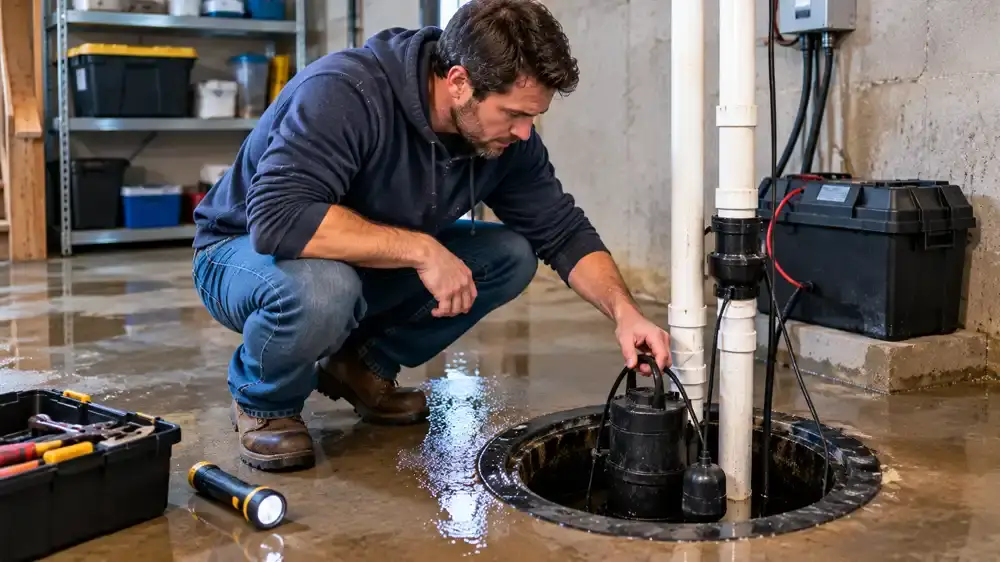
A sump pit collects groundwater from drains around your foundation. When the water rises, a float or sensor switches the pump on. The pump pushes the water out through a pipe, away from the house. When the pit empties, the pump shuts off.
That is the whole system. It also tells you where it can fail. Power, switch, pump, pipe and pit. Check them in that order.
Why this matters in Delaware
Many Sussex County homes have shallow water tables and flat lots. Pumps run a lot, especially after a big storm. On July 21, 2026, parts of southern Delaware got over 4 inches of rain, with more than 2 inches in about an hour, according to WDEL. Storms like that often knock out power too. A pump with no backup stops exactly when you need it most.
Test it before the next storm
Do this twice a year, and before hurricane season. Pour a bucket of water into the pit. The float should rise, the pump should start, and the water should drain. Watch the discharge pipe outside to make sure water leaves the house. If any step fails, use the troubleshooting list below.
Repair or replace
Most pumps last around 7 to 10 years, though heavy use shortens that. If yours is older and acting up, replacement is usually the smarter move. A new pump costs far less than a flooded basement. Think about the whole system while you are at it. A battery backup or a water-powered backup protects you during outages. A check valve stops water from running back into the pit. A larger pit or a second pump can help in storm-prone spots.
A working pump is not a dry basement plan
A pump moves water that reaches the pit. It does not stop water from entering in the first place. If your pump runs constantly or the basement still leaks, look upstream. Our guide to a basement leaking after rain explains how to fix gutters, grading and entry points. And if you want to turn the space into a living area, a dry, well-pumped basement is the starting line for a basement finishing project.
Symptoms and warning signs
- Pump does not turn on when the pit fills
- Pump hums but no water moves
- Pump runs constantly or cycles on and off every few seconds
- Pump is very loud, rattles or vibrates
- Water in the pit rises above the normal level
- Basement floor is wet and the pit is full
- Pump runs but water comes back down the pipe
Common causes
- No power: unplugged cord, tripped breaker or GFCI
- Stuck or tangled float switch
- Clogged intake screen or debris in the pit
- Failed motor from age or overheating
- Blocked, frozen or kinked discharge line
- Missing or failed check valve
- Pump too small for the water coming in
- Power outage with no battery backup
How to diagnose the problem
- Confirm the pump is plugged in and the outlet works. Reset the GFCI.
- Check the breaker panel for a tripped breaker.
- Lift the float by hand. If the pump starts, the float was stuck.
- Look in the pit for gravel, silt, mud or trash.
- Pour in a bucket of water and watch the pump cycle.
- Follow the discharge pipe outside. Make sure water exits and nothing blocks it.
- Listen for grinding, humming or rattling.
- Check the pump's age and any visible rust or cracks.
Tools and materials
Tools
- Flashlight
- Bucket
- Rubber gloves
- Wet-dry vacuum
- Screwdriver and adjustable pliers
- Hose
- Plumber's tape or pipe sealant
- Voltage tester for the outlet
Materials
- Replacement pump if needed
- Check valve
- Discharge pipe and fittings
- Battery backup kit (optional)
- Pit cover
- Pump cleaning supplies
Safety first
- Unplug the pump before touching it. Do not stand in water around the pump or outlet.
- Use a GFCI outlet for the pump.
- Do not take the cover off a pump that is wired directly. Call an electrician.
- Wear gloves. Pit water can carry bacteria.
- If water is near electrical equipment, shut off power at the panel only if you can do so safely. Otherwise call an electrician.
Step-by-step repair
- Unplug the pump and check the outlet with a tester.
- Reset the GFCI and check the breaker. Plug the pump back in.
- Lift the float. If the pump starts, free the float from the pit wall or other objects.
- Unplug again. Lift the pump out and clean the intake screen and the pit floor.
- Check that the check valve arrow points away from the pump, and that it is not stuck.
- Reinstall the pump. Pour water in the pit to test it.
- Check the discharge pipe outside. Clear leaves, ice or kinks, and make sure it empties well away from the house.
- If the pump still does not run, or it is more than about 7 to 10 years old, replace it.
- Add a battery backup if you have frequent outages.
Common mistakes to avoid
- Never testing the pump until a storm
- Leaving the discharge pipe pointed at the foundation
- Running the pump on a regular outlet with no GFCI
- Skipping the check valve
- Buying a pump that is too small
- Assuming a running pump means the basement is protected
Troubleshooting
- Pump runs but does not move water: the impeller may be clogged or the check valve may be stuck.
- Pump cycles every few seconds: the float is set too low or the check valve is failing.
- Runs nonstop: the pit may be too small, the float stuck up, or the water table is high. Check for a stuck float first.
- Loud rattle: debris or a worn bearing. Clean the pit or replace the pump.
- Water shows up outside near the foundation: the discharge line empties too close to the house.
Repair or replace?
Repair when the problem is a stuck float, a clogged screen or a tripped breaker. Replace when the pump is old, rusty, noisy or short-cycling after cleaning. Replace the check valve at the same time, since it is cheap and wears out.
When to call a professional
Call a pro if you have no pit but water keeps entering, if the pump is hardwired, or if the pit floods even with a working pump. Also call if the discharge needs rerouting, or if you want a battery backup and drainage system designed. Once the water is under control, we can help you use the space. See our finished basement services.
Delaware considerations
Storm outages and flat, wet ground make backup power a smart idea in southern Delaware. Test the pump before hurricane season, and again after any long power outage. Make sure the discharge line empties where it will not flow back toward your house or onto a neighbor's lot. Some towns have rules about discharge, so check with your local office. Your homeowners insurance may not cover sump failure unless you add a rider.
Frequently asked questions
Why is my sump pump not turning on?
Check power first: the cord, the outlet, the GFCI and the breaker. Then lift the float by hand. A stuck float is the next most common cause.
Why is my sump pump running constantly?
The float may be stuck, the check valve may be failing, or the pit may be taking in a lot of groundwater. After heavy rain, constant running can be normal for a while.
How often should I test my sump pump?
Test it every few months and before hurricane season. Pour water into the pit and make sure the pump starts and empties it.
How long does a sump pump last?
Many last about 7 to 10 years. Heavy use or poor maintenance shortens that.
Do I need a battery backup sump pump?
If storms often knock out your power, yes. A backup keeps the pit emptying during an outage, which is when flooding is most likely.
Can I replace a sump pump myself?
Often yes, if it plugs into an outlet and the piping is accessible. Hardwired pumps and major plumbing changes should go to a licensed pro.