

Quick summary
Basements are cool, damp and sit on concrete. This guide compares six floors that work below grade, which ones to avoid, and the moisture test to run first.
- Difficulty
- Intermediate
- Time
- 1 to 3 days depending on size and subfloor prep
- Material cost
- About $2 to $9 per square foot for materials, depending on the floor
- Read time
- 8 min
Rough retail ranges for materials only. Prep, subfloor panels, labor and trim add to the total. Concrete repairs and moisture control can change the budget.
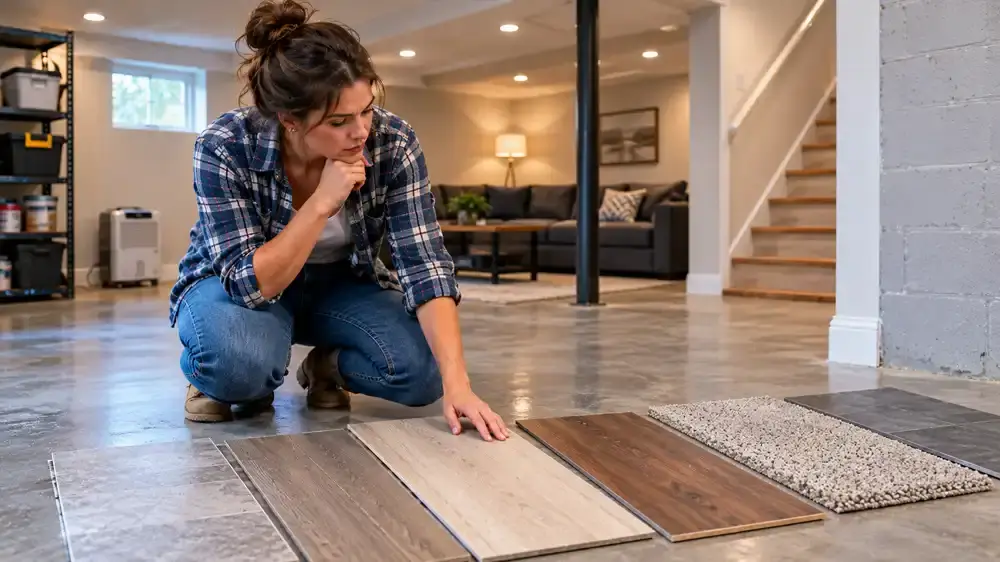
A basement floor has a hard job. It sits on concrete that stays cool. It deals with humidity and, now and then, water. A floor that looks great in a living room can warp, mold or peel down here.
Pick the right one, and you get a warm, durable floor for years. Pick the wrong one, and you tear it out in a season. Here is how to choose.
Test the slab before you buy anything
Every flooring warranty starts with the same question. Is the concrete dry? A slab can look fine and still push moisture up through the floor.
Try the simple plastic sheet test. Tape a 2 foot square of clear plastic to the slab on all four sides. Leave it for 48 hours. If the concrete looks darker under it, or you see water drops on the plastic, you have moisture moving through the slab. Do this in a few spots, and again after a rain.
For a more precise answer, use a concrete moisture meter, or ask a flooring supplier about an in-slab humidity test. If the slab is wet, fix the water first. Our guide to a basement leaking after rain walks through that.
Floors that work below grade
Luxury vinyl plank and tile
This is the most popular choice, and for good reason. It is waterproof, comfortable underfoot and comes in wood and stone looks. Choose a rigid core product rated for below-grade use. Cheap thin vinyl can show every bump in the slab.
Porcelain or ceramic tile
Tile does not care about water. It lasts for decades. The downside is that it feels cold and hard. Radiant heat mats under tile fix the cold, and they are a great upgrade in a family room or bathroom.
Sealed or epoxy-coated concrete
If the slab is in good shape, you can keep it. Grind it, seal it, and add an epoxy or stained finish. It is cheap and tough. Add area rugs so it is not cold and echoing.
Carpet tiles
Carpet squares let you swap out a stained piece. Many are backed with a moisture-resistant layer. They add warmth and sound control for a play area or home theater.
Subfloor panels with a top floor
Raised panels with a dimpled underside create a small air gap above the slab. They add a thermal break and let small amounts of vapor escape. You can lay vinyl, laminate rated for the space, or engineered wood on top, if the manufacturer allows it.
Rubber flooring
Rubber tiles and rolls are shock absorbing, waterproof and tough. They are a smart pick for a home gym or a workshop.
Floors to avoid
Solid hardwood swells and cups with moisture changes. Standard laminate has a fiberboard core that soaks up water. Both can fail fast in a basement. Even a single flood event can ruin them. Skip padded carpet over bare concrete too. It traps moisture and grows mold.
Plan the floor with the whole basement
The floor is one layer in a bigger system. Walls, insulation, ceiling height and lighting all affect which floor makes sense. A bathroom or laundry area may call for tile, while a media room may want carpet tiles or luxury vinyl. When our crew builds a finished basement, we choose floors zone by zone and set the floor height before drywall goes up. If you are adding a bathroom down there, the same thinking applies. See our bathroom remodeling work for how we handle tile and waterproofing.
Symptoms and warning signs
- Cold, hard concrete that makes the room uncomfortable
- Dark, damp spots on the slab
- Old floors that curl, buckle or smell musty
- Peeling adhesive or lifting tile edges
- Uneven or cracked concrete that telegraphs through thin flooring
Common causes
- Moisture vapor moving through the slab
- Floors chosen for upstairs use, not below grade
- No vapor barrier or subfloor layer
- Poor slab prep, such as dust, old glue or paint
- Recurring leaks or humidity left unaddressed
How to diagnose the problem
- Run the plastic sheet test in several spots for 48 hours
- Use a concrete moisture meter if you have access to one
- Check for cracks, high spots and low spots with a long straightedge
- Look for white powder on concrete, which signals moisture
- Measure ceiling height so you know how much floor build-up you can afford
- Check the manufacturer's below-grade requirements for any floor you want
Tools and materials
Tools
- Moisture meter or plastic sheet and tape
- Straightedge and level
- Floor scraper
- Utility knife
- Tape measure
- Spacers and a rubber mallet
- Wet saw or tile cutter for tile
- Trowel for patching and thinset
Materials
- Concrete patch or self-leveling compound
- Moisture barrier or vapor-rated underlayment
- Subfloor panels if you are using them
- Your chosen flooring and trim
- Adhesive or thinset rated for slabs
- Transition strips and baseboard
Safety first
- Wear a respirator when grinding or sanding concrete. The dust is hazardous.
- Wear knee pads and cut-resistant gloves around tile and vinyl.
- Test old floor tiles and adhesive for asbestos before you disturb them if the home was built before the 1980s.
- Ventilate the room well when using sealers, epoxies and adhesives.
Step-by-step repair
- Fix any water source first and confirm the slab stays dry.
- Remove old flooring, adhesive, paint and anything loose.
- Grind or scrape the slab clean and vacuum the dust.
- Patch cracks and fill low spots. Use a self-leveling compound if the floor is uneven.
- Lay a moisture barrier or subfloor panels if your floor requires it.
- Acclimate vinyl planks or tile to the room for the time the maker requires.
- Start laying from the longest, straightest wall. Leave an expansion gap at the walls.
- Cut and fit around doors, posts and the furnace area.
- Install transitions and baseboard, and cover the expansion gap.
- Keep furniture off for a day or two if you used adhesive.
Common mistakes to avoid
- Skipping the moisture test
- Laying solid wood or standard laminate on a slab
- Ignoring an uneven floor and hoping vinyl will hide it
- Gluing flooring directly to a wet slab
- Pushing flooring tight to the wall with no expansion gap
- Buying thin vinyl that is not rated for below grade
Troubleshooting
- Planks gap or buckle: the room was not acclimated or the gap at the wall was too small.
- Musty smell after install: moisture is trapped. Lift a small section and test the slab again.
- Tile cracks: the slab moved or was not flat. Check for a crack that needs a flexible membrane.
- Floor feels cold: add radiant heat, a thicker underlayment or area rugs.
- Edges curling on carpet tiles: humidity is high. Run a dehumidifier.
Repair or replace?
If your current floor is dry, flat and not moldy, a deep clean or refinish may be enough. If it is cupped, stained from moisture or smells musty, replace it. When the slab itself is wet, replacing the floor without fixing the water only gives you a new floor to ruin.
When to call a professional
Call a pro if the slab is cracked or uneven, if the moisture test is positive, or if you are tiling over a large area. Bring one in too if you plan to move walls, add a bathroom or re-grade the floor. Our basement finishing team handles the floor along with insulation, framing and drywall, so everything lines up.
Delaware considerations
Humid summers and a high water table make moisture the main concern in Delaware basements. Choose waterproof floors and keep a dehumidifier running from late spring through early fall. Near the coast, check your flood zone and consider materials that can be dried or replaced after a flood. Your insurance may treat finished flooring differently from the structure, so review your policy.
Frequently asked questions
What is the best flooring for a basement that might get wet?
Luxury vinyl plank or porcelain tile. Both handle water without swelling and can be dried and cleaned after a leak.
Can I put hardwood in a basement?
Solid hardwood is a poor fit. Engineered wood over a proper subfloor can work if the manufacturer approves it and the slab is dry. Moisture control is the key.
Do I need a vapor barrier under basement flooring?
Most floating floors need some barrier or rated underlayment over concrete. Check your product's instructions, since warranties often depend on it.
Is carpet okay in a basement?
Carpet tiles with moisture-resistant backing can work in dry basements. Avoid padded wall-to-wall carpet laid straight on bare concrete.
How much does basement flooring cost?
Materials range from a few dollars to nearly ten dollars per square foot, with prep and labor extra. A written estimate after a site visit is the only reliable number.
Should I put down flooring before or after the walls?
Walls and drywall usually go up first, and flooring goes in later. Your contractor will set the order based on the floor type and height.